
Bandra / Khar West
Ghatkopar West / R City Mall
Thane West / Hiranandani Estate
Thane / Majiwada / Lodha Paradise
Thane West / Chestnut Plaza
Navi Mumbai / Kokilaben DAKC
Andheri East / Apollo Chakala
Andheri West / DLH Plaza
Bandra / Khar West
Ghatkopar West / R City Mall
Thane West / Hiranandani Estate
Thane / Majiwada / Lodha Paradise
Thane West / Chestnut Plaza
Navi Mumbai / Kokilaben DAKC
Andheri East / Apollo Chakala
Andheri West / DLH Plaza
Sedation vs Local Anesthesia Guide
Is Nitrous Oxide Better Than Local Anesthesia?
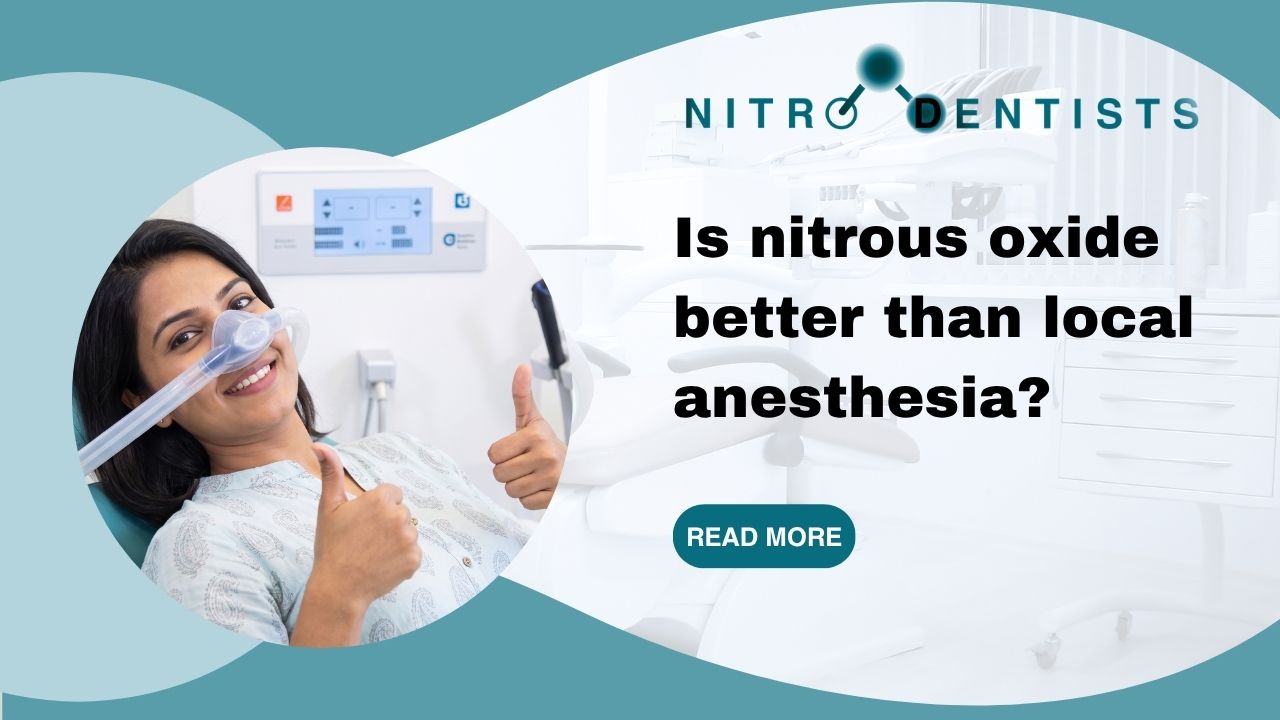
Understanding Anxiety Control vs Pain Interruption in Modern Dentistry
When preparing for a dental procedure—whether it is a routine tooth filling, a root canal treatment, or dental extractions—one of the most common questions patients ask is: "Is Nitrous Oxide better than local anesthesia?"
The short clinical answer is that neither is strictly 'better' because they perform completely different functions. Nitrous Oxide sedation (commonly called laughing gas) targets your central nervous system to help reduce fear, stress, and dental apprehension. In contrast, local anesthesia targets specific nerve pathways in your gums and tooth to block physical pain signals. In fact, at Nitro Dentists clinics across Mumbai, Thane, and Pune, our specialists frequently use both in combination to provide a relaxed, comfortable experience.
Quick Comparison
Nitrous Oxide vs Local Anesthesia at a Glance
Here is how these two essential dental comfort techniques compare in purpose, mechanism, and recovery.
Primary Purpose
Nitrous Oxide: Manages anxiety, dental apprehension, gag reflexes, and stress by inducing calm conscious sedation.
Local Anesthesia: Temporarily blocks pain impulses from target nerves in the tooth and surrounding soft tissue.
Administration Method
Nitrous Oxide: Inhaled gently through a comfortable nasal mask mixed with medical-grade oxygen.
Local Anesthesia: Administered via tiny targeted injections (after applying numbing gel) directly near the treatment area.
Onset & Duration
Nitrous Oxide: Takes effect within 2–3 minutes; clears within minutes after inhaling pure oxygen.
Local Anesthesia: Takes effect in 3–5 minutes; numbing lingers for 2–4 hours post-treatment.
Post-Treatment Driving
Nitrous Oxide: Many adult patients can drive post-treatment after dentist evaluation as the gas clears rapidly.
Local Anesthesia: Driving is generally permitted, though lips and cheeks remain temporarily numb.
Pediatric Suitability
Nitrous Oxide: Beneficial for children who feel nervous, apprehensive, or sensitive to dental sounds.
Local Anesthesia: Standard for pediatric fillings and extractions, used alongside friendly behavioral techniques.
Combined Usage
Effective Synergy: Dentists routinely combine both! Nitrous Oxide helps relax you so you feel calm, while local anesthesia provides targeted regional numbing during the procedure.
Conscious Sedation
How Nitrous Oxide Works in Dentistry
Nitrous Oxide ($N_2O$) is a colorless, sweet-smelling, non-irritating gas administered in combination with medical-grade oxygen ($O_2$). It acts quickly on the central nervous system, releasing neurotransmitters that induce a light, pleasant state of relaxation.
- Maintains Full Consciousness: You stay awake, swallow normally, and can talk with your dentist throughout the appointment.
- Raises Pain Threshold: While it provides mild analgesic (pain-relieving) properties, its primary benefit is reducing emotional reactivity and anxiety.
- Suppresses Hyperactive Gag Reflex: Ideal for patients who gag during dental impressions, X-rays, or posterior tooth treatments.
- Rapid Flush-Out: As soon as the gas is turned off and pure oxygen is inhaled for several minutes, the sedation effect dissipates. Read more on how long Nitrous Oxide stays in your system.
Patient Experience Under Nitrous Oxide
Under Nitrous Oxide, patients commonly describe feeling:
A pleasant, light floating or warm tingling sensation in arms and legs.
A sense of calm, emotional distance from dental sounds or vibration.
Time passing much quicker than expected during lengthy treatments.
Targeted Numbing
How Local Anesthesia Works in Dentistry
Local anesthesia involves placing a precise chemical agent (such as Lidocaine or Articaine) directly around the nerve endings supplying the tooth, gums, or jawbone. It temporary blocks sodium channels, preventing nerve pain signals from traveling to your brain.
- Targeted Regional Numbing: Helps prevent procedural pain during treatments like dental implants, root canals, or extractions.
- Topical Pre-Treatment Gel: At Nitro Dentists, a high-grade topical numbing gel is applied to the gum tissue first so you barely feel the minor pinch of the injection.
- Focused Control: Keeps only the target area numb while leaving your mind completely clear and unaffected.
- Duration: Provides 2 to 4 hours of post-procedure comfort, helping manage immediate surgical pain after you leave the clinic.
Clinical Role of Local Anesthesia
Local anesthesia is essential whenever a dental treatment works near nerve pulp, dentin, or bone tissue:
Essential for deep decay, cavity preparations, and crown bridge work.
Crucial for nerve extirpation during single-visit or multi-visit root canals.
Prevents surgical discomfort during simple or wisdom tooth extractions.
Feature Comparison
Nitrous Oxide vs Local Anesthesia Matrix
A side-by-side technical summary to help you understand which option fits your clinical needs.
| Feature | Nitrous Oxide (Laughing Gas) | Local Anesthesia (Numbing Shot) |
|---|---|---|
| Target Effect | Central Nervous System (Mind & Relaxation) | Peripheral Nerves (Tooth & Gum Numbness) |
| Pain Elimination Depth | Mild analgesia; relaxes pain perception | Targeted regional nerve numbing |
| Anxiety & Fear Control | High; helps reduce anxiety & dental fear | None; does not alter stress or anxiety |
| Delivery Instrument | Soft nasal breathing mask | Targeted fine-gauge dental injection |
| Recovery Time | Clears within minutes after pure oxygen | 2 to 4 hours post-procedure |
| Driving After Visit | Follow dentist post-treatment guidance | Permitted, but lip/cheek remain numb |
| Gag Reflex Control | Helpful suppression of gag reflex | No effect on gag reflex |
| Best Suited For | Nervous patients, kids, needle apprehension | Root canals, extractions, fillings, surgical care |
Target Effect
Nitrous Oxide:
Central Nervous System (Mind & Relaxation)
Local Anesthesia:
Peripheral Nerves (Tooth & Gum Numbness)
Pain Elimination Depth
Nitrous Oxide:
Mild analgesia; relaxes pain perception
Local Anesthesia:
Targeted regional nerve numbing
Anxiety & Fear Control
Nitrous Oxide:
High; helps reduce anxiety & dental fear
Local Anesthesia:
None; does not alter stress or anxiety
Delivery Instrument
Nitrous Oxide:
Soft nasal breathing mask
Local Anesthesia:
Targeted fine-gauge dental injection
Recovery Time
Nitrous Oxide:
Clears within minutes after pure oxygen
Local Anesthesia:
2 to 4 hours post-procedure
Driving After Visit
Nitrous Oxide:
Follow dentist post-treatment guidance
Local Anesthesia:
Permitted, but lip/cheek remain numb
Gag Reflex Control
Nitrous Oxide:
Helpful suppression of gag reflex
Local Anesthesia:
No effect on gag reflex
Best Suited For
Nitrous Oxide:
Nervous patients, kids, needle apprehension
Local Anesthesia:
Root canals, extractions, fillings, surgical care
Clinical Synergies
The Power of Combination Therapy: Why Use Both?
Rather than asking which is better, leading dental specialists recommend combining Nitrous Oxide with local anesthesia for complex or anxiety-inducing treatments.
01
Step 1: Inhalation of Nitrous Oxide
You sit back in the dental chair and breathe pure oxygen mixed with Nitrous Oxide. Within 2 to 3 minutes, a soothing wave of calm washes over you, dissolving apprehension about needles, drills, or clinic environment. Learn more about benefits of Nitrous Oxide for anxious dental patients.
02
Step 2: Gentle Local Anesthesia Administration
Once you are completely relaxed under laughing gas, your dentist applies a pleasant-flavored topical numbing gel, followed by the local anesthetic shot. Because your anxiety is reduced and your pain threshold is elevated by Nitrous Oxide, the injection is much easier to tolerate.
03
Step 3: Effective Procedural Comfort & Rapid Recovery
The local anesthetic provides targeted regional numbing during the procedure. Once finished, breathing pure oxygen for several minutes helps clear the gas, leaving you clear-headed, refreshed, and comfortable.
Clinical Insight: This combination approach is widely recognized as an effective combined approach for treating anxious adults and children undergoing root canals, extractions, or cosmetic smile makeovers.
Location Network
Painless Nitrous Oxide Dentistry Across Nitro Dentists Clinics
All Nitro Dentists clinics feature certified MDS specialists, advanced 3D digital imaging, and calibrated Nitrous Oxide conscious sedation equipment.
Serving Diamond Garden, Govandi East, Central Avenue, Tilak Nagar, and Deonar. Offering single-visit RCT, painless extractions, and Nitrous Oxide sedation.
Visit Chembur ClinicLocated on SV Road above Noble Chemist. Specializing in cosmetic smile designing, clear aligners, and pain-free pediatric dentistry.
Visit Khar ClinicConveniently located near Turner Road and Hill Road. Providing full mouth rehabilitation, dental implants, and sedation care.
Visit Bandra ClinicAccessible from Lokhandwala and Veera Desai. Multispecialty dental care with dedicated sedation suites for nervous patients.
Visit Andheri ClinicServing Majiwada and Hiranandani Estate with state-of-the-art 3D imaging and painless sedation dentistry.
Visit Thane ClinicsCentrally located in Kalyani Nagar and Shivajinagar, delivering advanced restorative and surgical dental care.
Visit Pune Clinics
FAQ
Frequently Asked Questions
Neither is universally 'better' because they fulfill entirely different clinical functions. Nitrous Oxide (laughing gas) relaxes your mind and eases anxiety, whereas local anesthesia numbs the tooth and surrounding nerves to eliminate physical pain. For invasive procedures like root canals or extractions, dentists typically use both together for maximum comfort.
For mild or non-invasive procedures such as superficial teeth cleaning or minor fillings in anxious patients, Nitrous Oxide alone may provide enough relaxation and mild analgesia. However, for deeper dental work involving nerve tissue or bone, local anesthesia is still required to block nerve pain signals completely.
No. Nitrous Oxide is a form of conscious sedation. You remain fully awake, conscious, and able to respond to your dentist's instructions, but you feel deeply relaxed, calm, and indifferent to dental sounds or stress. Read our guide on laughing gas safety in dental treatments for more details.
Nitrous Oxide wears off within 3 to 5 minutes after switching to pure oxygen at the end of the appointment, allowing adult patients to drive themselves home or return to work immediately. In contrast, local anesthesia numbing typically lasts 2 to 4 hours.
Combining both options offers the ultimate painless dental experience. Nitrous Oxide relieves needle phobia and dental anxiety so you do not mind the initial local anesthesia injection, while the local anesthesia ensures complete physical numbness during the treatment. Explore our article on Nitrous Oxide vs Oral Sedation for further comparisons.
Experience Stress-Free Dental Care at Nitro Dentists
Whether you require Nitrous Oxide conscious sedation for dental anxiety, precise local anesthesia, or a combination of both, our experienced MDS dental specialists are dedicated to making every visit comfortable and pain-free.
Verify Your Phone
We've sent an OTP to your phone. Please enter it below to complete your request.